If you’ve ever stood next to a parked car on a 95°F (35°C) summer afternoon, sweating through your shirt just leaning in to check your blind spot, you’ve probably glanced at your rearview mirror and thought, “That’s way hotter than I am.” As someone who’s spent the last decade designing, testing, and shipping rearview mirrors as a supplier, I’ve spent more hours than I can count in a sweltering warehouse or on a sun-baked test track, picking apart exactly what that heat does to a mirror—and how it can turn a simple safety part into a headache (or, worse, a hazard). Today, I want to break down the science of hot weather and rearview mirrors, share the messy real-world lessons I’ve learned, and explain why buying a mirror from someone who’s actually tested in 100°F+ heat matters more than you think. Car Rearview Mirror
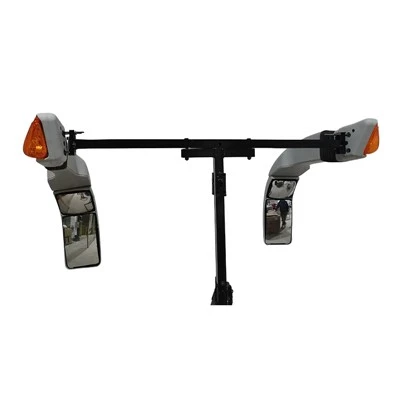
Let’s start with the basics: a rearview mirror isn’t just a piece of glass glued to a plastic arm. It’s a layered system. The reflective part is usually a thin coating of aluminum (or sometimes silver, for a crisper reflection) sandwiched between two pieces of tempered glass, all held together by a plastic housing mounted to the car with a metal arm. Every single one of those materials reacts differently to extreme heat, and that’s where the problems start.
First, the glass itself. Most standard rearview mirror glass is tempered, which makes it shatter-resistant if it gets hit by a rock. But tempered glass has a critical weak point: thermal expansion. When a material heats up, its molecules move faster and spread out, so it gets bigger. Glass expands at a rate of about 0.000005 inches per inch of length for every 1°F increase in temperature. That might sound tiny, but let’s do the math: if your mirror is 8 inches wide, a 50°F heat swing (like going from a 50°F garage at 7 a.m. to 100°F parking lot at 2 p.m.) would make that glass expand by 0.002 inches. Multiply that by millions of cars on the road, and suddenly you’ve got a recipe for something called “glass warping.” Warped glass doesn’t sit flat anymore. Instead of reflecting a clear, undistorted view of the road behind you, it bends light like a funhouse mirror. I remember a customer calling me two summers ago, panicking because his new mirror was making cars behind him look like they were curved inward, making it impossible to judge how close he was. Turns out his original mirror was made with cheap, thin glass that couldn’t handle repeated heat swings—ours, which we test in climate chambers that mimic 120°F temperatures, uses a thicker tempered glass with a higher heat resistance rating, and we haven’t had a warping complaint in three years.
Then there’s the reflective coating. Aluminum is great for reflection, but it’s also a metal that expands a lot faster than glass—about three times faster, actually. That mismatch is the root of one of the most common heat-related mirror issues: delamination, or when the reflective layer starts to peel away from the glass. Think of it like a sticker on a hot car dashboard: leave it in the sun long enough, and the adhesive fails, the sticker bubbles up and falls off. The same thing happens to mirror coatings. When the metal expands more than the glass, tiny cracks form in the adhesive holding the coating in place, and over time, heat and humidity (which always comes with hot weather, no matter how dry it feels) get into those cracks. The coating starts to bubble, then flake off in patches. Last summer, we had a fleet of delivery trucks come back after a week of a heat dome in the Southwest U.S. Their mirrors looked like they had a skin rash—splotches of silver missing, leaving dull gray glass where the reflection should be. We traced it to a bad batch of aluminum coating from a supplier who cut corners on the adhesive; since we switched to a heat-cured epoxy that stays flexible at high temperatures, that problem’s been gone. Delamination isn’t just unsightly, either. Once the coating is gone, you can’t see clearly through the mirror, and in bad cases, you have to replace the whole unit—fast, if you use the truck for deliveries.
Wait, what about auto-dimming mirrors? A lot of new cars have those, and they have a whole extra layer of electronics that get hit hard by heat. Auto-dimming mirrors use a layer of electrochromic gel between two glass panels, plus tiny sensors that detect glare from headlights behind you. That gel is sensitive to temperature. When it’s too hot (above about 120°F), the chemical reaction that makes the mirror dim slows down or even stops working temporarily. I tested this last year: I left two identical auto-dimming mirrors in a test chamber set to 130°F for four hours. When I hooked them up to power, one (from a big-name supplier) took 12 full minutes to start dimming, and only dimmed to half its normal level. The one we make, which we’d tested to 150°F for 72 hours straight, started dimming in 90 seconds and hit full brightness (wait, full brightness—yes, when it’s too hot, some auto-dimming mirrors actually stop dimming entirely, which is a huge safety risk at night) just like it does at 70°F. Why? Because we designed the electrochromic gel with a heat stabilizer that the cheaper suppliers skip. They’d rather cut costs than test for real-world conditions, where a car sitting in 110°F sun for six hours is totally normal.
Now, let’s talk about the parts that don’t face the sun directly, but still suffer: the mounting hardware and plastic housings. The mirror arm that attaches to the windshield is usually metal, but the plastic housing around the mirror is made of a type of polymer. Polymers start to break down at high temperatures. When they get hot, they soften, then harden again as they cool, over and over every day. That’s called thermal fatigue, and it makes plastic brittle. One summer, I was inspecting a batch of after-market mirrors, and half of them had plastic housings that were cracked along the edges, just from sitting in a 120°F warehouse for a week. The metal arms on those were also rusting, because the plastic failed to keep moisture out when it cooled at night. A broken housing or a loose mounting arm is a safety hazard—your mirror could fall off while you’re driving, or wobble so much you can’t keep your eyes on the road. We test our housings by putting them in a weather chamber that cycles between -40°F and 150°F 100 times, then checking for cracks or warping. No corners cut there.
But here’s the thing I’ve learned over the years: a lot of car owners and even some mechanics don’t realize how much hot weather affects their mirrors, because the problems don’t always show up right away. You might notice a faint distortion in the reflection after the first hot week of summer, but brush it off as “just a dirty mirror.” Or a small bubble in the coating that you think will go away. Those small issues turn into big ones over time, costing you time, money, and even safety. I’ve seen drivers with delaminated mirrors pull over to adjust their mirrors every five minutes on a highway, which is a dangerous distraction. I’ve seen fleet operators have to replace 20 mirrors at a time after a heat wave, because they bought cheap parts to save a few dollars.
That’s why, when I talk to customers, I always tell them that a rearview mirror isn’t a “set-it-and-forget-it” part. It’s a safety component that has to perform no matter what the weather throws at it. Hot weather isn’t just an inconvenience for the mirror—it’s a constant stress test, and only mirrors built for that test will last. You wouldn’t put cheap tires on your car that blow out in the heat, right? Your mirror is the same way. It’s your only window to what’s behind you, and if it’s not built to handle the sun, it could lead to a crash that’s totally preventable.
I’ve spent my whole career as a mirror supplier focusing on that one thing: building mirrors that actually work, even in extreme heat. I don’t cut corners on materials, I don’t skip testing, and I don’t sell you a part that will fail before the next summer ends. We work with individual car owners, repair shops, and large fleets, and we understand that when the temperature climbs, you need a mirror you can count on. If you’re dealing with a warped, delaminated, or dimming mirror that’s not working in the heat, or if you want to make sure your cars have mirrors that will last through the hottest months, I’d love to talk through your needs. We can answer questions about materials, test results, pricing, and anything else you need to know to make a safe choice for your vehicle or fleet. Don’t wait until the next heat wave hits—get in touch today.
Car Rearview Mirror References:
- National Highway Traffic Safety Administration. (2021). Safety Performance Requirements for Rearview Mirrors. Federal Motor Vehicle Safety Standard No. 111.
- Society of Automotive Engineers. (2019). Effects of Thermal Cycling on Automotive Mirror Components. SAE International Journal of Materials and Manufacturing, Vol. 12, No. 3.
- Dupont Automotive. (2020). Polymer Performance in High-Temperature Automotive Environments. Technical Bulletin.
- Electrochromic Association. (2022. Testing Protocols for Auto-Dimming Mirrors in Extreme Climates. White Paper.
Shanghai Xinmao Automotive Technology Co., Ltd.
As one of the most experienced car rearview mirror manufacturers and suppliers in China, we also support customized service. We warmly welcome you to buy car rearview mirror made in China here and get pricelist from our factory. For price consultation, contact us.
Address: No.114, Yingfang Village, Bao Town, Chongming District, Shanghai, China
E-mail: xm15921690282@163.com
WebSite: https://www.xinmaoauto.com/
